
VP of group sustainability Anthony Abbotts unpacks the decarbonisation journey and paradox the cable producer is navigating
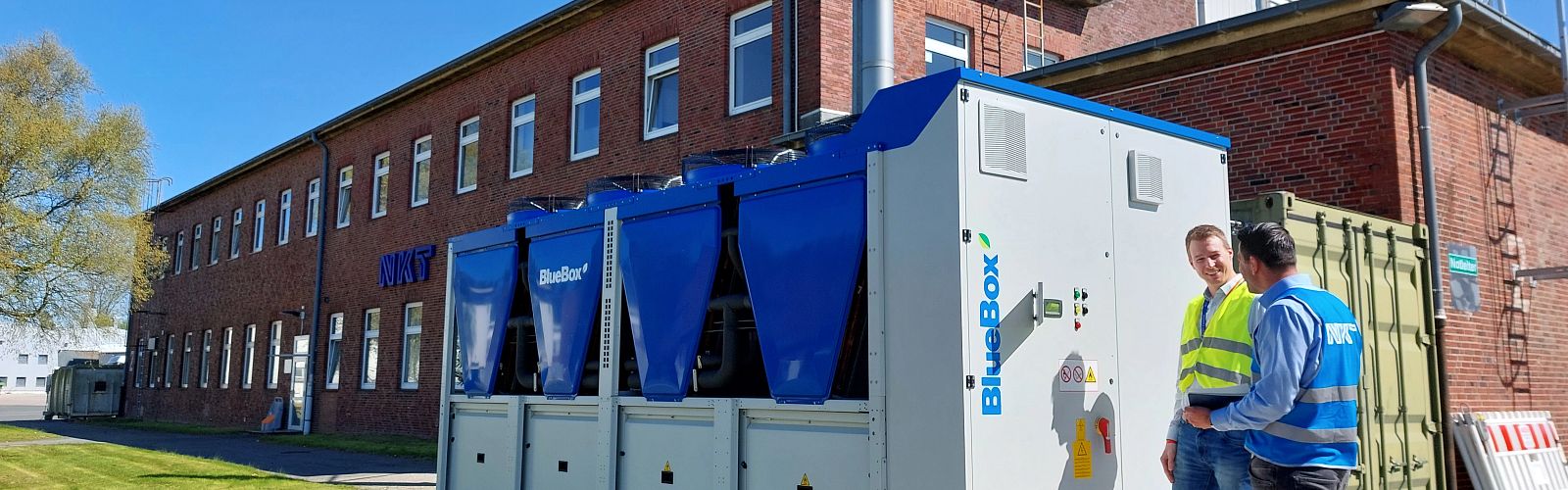
If you ever have the chance to visit NKT’s factory in Nordenham, about 70 kilometres north of the German city of Bremen, you’ll be greeted by a sign constructed by the factory’s employees declaring it the first in the company’s portfolio to reach zero carbon emissions in Scopes 1 and 2.
For the people working there, that status has become a source of enormous pride. The decarbonisation project is now part of the factory’s identity, with the fact that Nordenham got there first carrying particular significance.
For NKT more broadly, the ‘zero carbon factory’ is a signal of its ambition and direction of travel.
The changes made at Nordenham may have had a “small impact” on the lifecycle carbon intensity of the accessories produced there, but the value of reaching zero carbon goes beyond the tonnes of emissions directly removed.
“It’s brought a lot of pride to the staff at the factory and customers think that this is really cool,” says Anthony Abbotts, NKT’s vice president of group sustainability. “The story itself has a value because it’s showing that NKT wants to push the agenda and we have high ambition.”
A multi-year conversion
None of which means decarbonising the factory was easy, inexpensive or insignificant. It required a multi-year conversion of the site’s energy system, effectively engineering natural gas out of the factory.
There were four broad steps. First, NKT has procured 100% renewable electricity across its manufacturing footprint since 2022, eliminating the company’s Scope 2 emissions from manufacturing. In February 2026, it signed a new long-term agreement with Uniper through which electricity from a new photovoltaic facility in Wilhelmshaven will be supplying the Nordenham factory, as well as another production site in Cologne.
Second, fossil fuel-powered vehicles and forklifts were phased out by 2024 and replaced with electric alternatives. Third, NKT redesigned the heating system to recover and reuse heat the factory was already producing.
And, finally, natural gas was removed from the heating system and replaced with industrial heat pumps, changing the factory’s energy architecture while eliminating its remaining Scope 1 emissions.
According to Abbotts, the result is an annual carbon reduction of 576 tonnes, alongside lower energy consumption per product produced at the site.
“There was a lot of planning associated with actually doing this, making sure that we’re finding the right solution,” he adds.
“You need to look at what additional electricity consumption you’re going to have, and if you have the necessary supply that is not going to be compromised if we increase the consumption levels. But I actually think we are far more resilient today than we were when we were using natural gas.”
That makes Nordenham an efficiency and resilience story. But NKT’s wider decarbonisation programme is a commercial one too.
NKT makes the power cables and cable systems that carry electricity through grids and major infrastructure. Its customers include Transmission System Operators (TSO), Distribution System Operators (DSO), utilities, power generators, data centres, energy companies and developers – many of which have significant carbon reduction targets of their own.
That means the carbon embedded in NKT’s products matters to the buyer. The lower the carbon intensity of a cable system, the more attractive it can become as a product. Decarbonisation therefore forms part of the proposition: the carbon embodied in a kilometre of cable sits alongside performance, reliability and price as another characteristic on which it can be evaluated.
That is why NKT conducts lifecycle analyses of its cables, taking into account the materials it buys and uses – including copper, aluminium and plastics – as well as manufacturing, installation and, ultimately, end of life.
Footprint vs handprint
But NKT’s position in the energy transition creates an interesting paradox.
While the company has what Abbotts describes as “an aggressive decarbonisation programme”, there is also an acceptance that its absolute emissions could rise as demand for electrification – and therefore for its products – grows.
In 2025, NKT’s revenue increased by 10% to €3.5bn year-on-year, and has grown 72% since 2022.
“Our biggest, most significant impact on climate change is through the products and services that we’re actually offering to the market. That means we’re challenged because we have this enormous growth,” Abbotts says.
“But, ultimately, we’re installing cables in countries like Germany and Poland, which are still dependent on fossil fuels, to help them move towards net zero. A prerequisite for those countries to get to net zero is that we need those emissions in the short-term. These emissions are accounted for in NKT’s Scope 3”
NKT’s climate impact, argues Abbotts, cannot therefore be understood through its carbon footprint alone.
There is the footprint: the emissions associated with its own operations, products and supply chain, which the company is trying to reduce. And there is the handprint: the much larger system-level decarbonisation that the infrastructure it manufactures makes possible.
Nordenham will not remain an isolated project. NKT plans to phase out natural gas at its other factories wherever the technology allows, applying the same broad principle – reduce energy demand, then electrify what remains – across its manufacturing footprint.
But replicating the ambition will not necessarily mean replicating the technology.
At some NKT factories, removing natural gas would expose another source of emissions: methane released during the degassing of plastics used for cable insulation.
Today, those emissions are relatively small compared with the natural gas consumed on site. Once gas disappears, however, they become more significant.
That is one of the next problems NKT is trying to solve, which points to something important about industrial decarbonisation. While Nordenham demonstrates how far established technologies – renewable electricity, electrification, heat pumps and heat recovery – can already take an industrial site, it is not a universal blueprint.
Different manufacturing processes leave different residual emissions. And as the largest and easiest-to-address sources disappear, getting from much lower carbon to zero becomes increasingly dependent on the specifics of how individual products are made.
Nordenham, then, is unlikely to represent an end point. It is better understood as evidence of how far industrial decarbonisation can already go, and of the more complicated problems that emerge once the obvious sources of emissions have been engineered out.



Leave a Reply